
If your For You Page has turned into a shrine of glass skin transformations, you’ve already met the tiny pink bottle sending K-beauty forums into a frenzy: the medicube PDRN Pink Peptide Serum. Between the salmon DNA headlines and the “10,000ppm” flex printed right on the box, this ampoule has become the unofficial mascot of Korea’s regenerative skincare wave — and it’s finally having its moment with global shoppers.
At WEMMERCE, we don’t just chase viral labels — we read the ingredient deck. So we pulled apart what PDRN actually is, why medicube paired it with a five-peptide complex, and whether this serum earns a permanent spot in your routine or is simply riding the salmon-sperm-extract news cycle. Let’s get into it.
This isn’t medicube’s first viral hit — the brand has already built a global reputation through its Zero Pore Pad and Age-R Booster Pro device, both of which turned “Korean dermatology-inspired” into a household phrase for English-speaking skincare fans. The PDRN Pink Peptide Serum continues that same playbook: take a treatment normally reserved for in-clinic procedures, translate the science into a stable topical formula, and package it in a way that feels approachable rather than intimidating. That’s precisely why it’s worth a closer, ingredient-first look before you add it to cart.
The PDRN Trend: Why Korea Is Obsessed With “Salmon DNA” Skincare
PDRN stands for Polydeoxyribonucleotide — a purified DNA fragment, most commonly derived from salmon milt (Milt Extract, which you’ll spot on the ingredient list). It started its career in Korean dermatology clinics, used in injectable “salmon skin boosters” to accelerate tissue repair after laser treatments. Naturally, K-beauty labs did what they do best: they took a clinical-grade active and reformulated it for at-home topical use.
Here’s the science in plain terms: PDRN works as a cell-communicating ingredient. It signals fibroblasts — the cells responsible for producing collagen and elastin — to ramp up repair and regeneration activity. Clinically, it’s associated with:
- Improved skin elasticity and firmness over time
- Faster-looking recovery for a dull, tired, or stressed complexion
- Support for the skin barrier’s natural repair cycle
- A visibly bouncier, more “cushiony” skin texture
This is the ingredient that quietly powered Korea’s rise as a biotech-driven beauty hub — the same country that gave the world snail mucin and centella asiatica is now exporting DNA-repair science in a $30 bottle. Global search interest for “PDRN skincare” and “salmon DNA serum” has climbed steadily as TikTok dermatologists and K-beauty retailers like Olive Young spotlight it as the successor to retinol-fatigued routines: an active that focuses on repair and resilience rather than aggressive exfoliation.
This shift mirrors a broader movement happening across the entire K-beauty export market right now. Where the last global wave was defined by glass-skin hydration (think snail mucin, hyaluronic acid multi-layering) and the wave before that by gentle chemical exfoliation (PHA, mandelic acid), 2025–2026 is shaping up to be the era of biotech and regenerative actives: PDRN, exosomes, growth-factor complexes, and fermented peptide serums. Korean labs have a decades-long head start in this space because so many formulas originate from — or are co-developed alongside — dermatology clinics, not just cosmetic chemistry departments. That clinical pedigree is exactly why global buyers are willing to pay a premium for Korean-formulated PDRN over generic alternatives.
PDRN vs. Retinol vs. Collagen: What’s the Difference?
Shoppers new to PDRN often ask how it compares to the anti-aging actives they already know. Here’s the honest breakdown:
- PDRN vs. Retinol: Retinol accelerates cell turnover and can cause purging, dryness, or sun sensitivity during the adjustment period. PDRN works through a different mechanism — cell signaling rather than exfoliation — so it typically comes with far less irritation, making it a strong option for those who can’t tolerate retinoids or want a gentler entry point into anti-aging skincare.
- PDRN vs. Topical Collagen: Collagen molecules applied topically are generally too large to penetrate deeply; they mostly sit on the surface providing temporary plumping and moisture-barrier support. PDRN, by contrast, is thought to work at a deeper cellular level, encouraging the skin to support its own collagen and elastin production rather than simply supplying a temporary surface film.
- PDRN vs. Peptides alone: Peptides and PDRN are complementary, not competing — which is exactly why medicube combined them. Peptides act as messengers that trigger specific repair pathways, while PDRN provides the broader regenerative signal. Used together, as in this formula, they reinforce the same collagen-elastin support system from two angles.
Not Just PDRN: The “Pink Peptide” Half of the Formula
medicube didn’t stop at PDRN. The “Pink Peptide” naming refers to a five-peptide complex layered into the formula — including Copper Tripeptide-1, Acetyl Hexapeptide-8, Palmitoyl Pentapeptide-4, Palmitoyl Tripeptide-1, and Palmitoyl Tetrapeptide-7. Peptides are short chains of amino acids that act as messengers, reinforcing the same collagen-signaling pathway that PDRN activates. Pair that with Hydrolyzed Collagen, Sodium Hyaluronate, and Niacinamide for hydration and tone-evening, and you get a formula built around one core idea: skin that looks like it repaired itself overnight.
Full Review: medicube PDRN Pink Peptide Serum
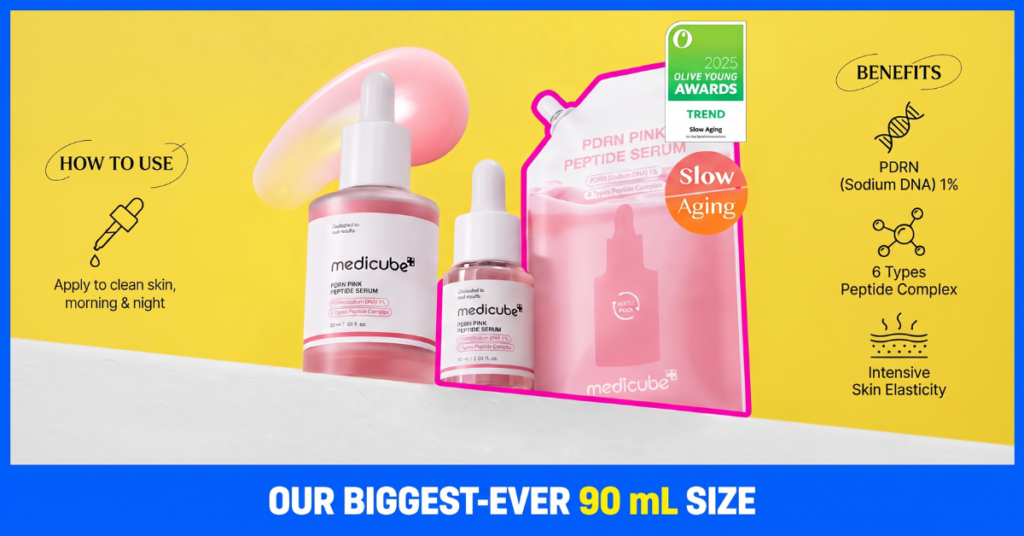
The version currently trending globally is the medicube PDRN Pink Peptide Serum 30ml + 50ml Refill Set — a smart packaging move that immediately signals this is meant to be a long-term staple, not a one-off trial purchase.
Packaging & First Impressions
The set arrives as a 30ml core bottle paired with a 50ml refill pouch — a format that’s becoming a signature move for Korean skincare brands trying to reduce packaging waste while offering better value per use. The pump bottle is opaque, which helps protect the light-sensitive actives inside, and the soft pink color-coding makes it instantly recognizable on a crowded vanity shelf. It’s a small detail, but the refill system also means you’re not paying for a brand-new outer bottle every time you repurchase, which noticeably improves the cost-per-milliliter over a full year of use.
Texture & Sensorial Experience
The serum has a lightweight, faintly pink-tinted gel-cream texture that sinks in without pilling — a detail that matters if you’re layering it under makeup or SPF. It’s not sticky, and the light, clean scent fades quickly. For a formula this actives-dense, the finish feels surprisingly soft and cushiony rather than clinical.
Key Ingredients Breakdown
- Sodium DNA + Milt Extract (PDRN source): the regenerative core of the formula, supporting elasticity and tissue repair signaling.
- 5-Peptide Complex: Copper Tripeptide-1, Acetyl Hexapeptide-8, and three Palmitoyl peptides reinforce firming and smoothing effects.
- Niacinamide: evens tone, supports barrier function, and calms visible redness.
- Hydrolyzed Collagen + Sodium Hyaluronate: multi-weight hydration that plumps the surface layer instantly.
- Adenosine: a Korean-favorite, dermatologically studied anti-wrinkle functional ingredient often paired with PDRN formulas.
What We Loved
- Genuinely lightweight despite the “rich actives” formula on paper
- Refill set format reduces plastic waste and cost-per-use over time
- No detectable stickiness — layers cleanly under moisturizer and sunscreen
- Visible bounce and hydration improvement reported within 1–2 weeks of consistent use
Worth Noting
- Contains fragrance (Parfum) — fragrance-sensitive users should patch test first
- Results on deep elasticity loss build gradually; this is a maintenance-and-prevention serum, not an overnight fix
- Best paired with SPF, since any actives-forward routine benefits from daytime sun protection
Who Should Buy It: Recommendations By Skin Type & Concern
One of the reasons this serum crossed over from Korean beauty counters to global bestseller lists is its versatility. Here’s how it performs across different skin profiles:
- Dry / Dehydrated Skin: The combination of Sodium Hyaluronate, Glycerin, and Hydrolyzed Collagen delivers immediate surface hydration, while PDRN supports longer-term barrier resilience — ideal for skin that looks flat or tight by midday.
- Mature Skin / Early Aging Concerns: This is the serum’s home turf. The PDRN-peptide combination is specifically formulated to target loss of bounce, fine lines, and elasticity — a gentler, non-irritating alternative or companion to retinol.
- Dull, Stressed, or “Tired-Looking” Skin: If your complexion looks lackluster after travel, poor sleep, or seasonal change, the regenerative signaling of PDRN combined with Niacinamide’s brightening effect gives an immediate “reset” look.
- Sensitive Skin: The formula is largely conditioning and soothing (Centella-adjacent actives, no alcohol denat., no harsh acids), but because it contains fragrance, we recommend a 48-hour patch test on the inner arm before full-face application.
- Oily / Acne-Prone Skin: The gel-cream texture absorbs quickly and doesn’t feel heavy, though those actively managing breakouts may want to introduce it gradually alongside — not in place of — their acne-focused actives.
- Combination Skin: Because the formula balances hydration with a lightweight finish, it works well across mixed zones — the humectant-rich texture won’t overload an oily T-zone while still delivering enough moisture for drier cheeks.
Climate is worth factoring in too. In drier, low-humidity environments — think winter in the northeastern US, the UK, or inland Australia — layering this serum under a richer occlusive moisturizer will maximize the hydration payoff. In humid climates, a single layer plus a lightweight gel moisturizer is usually enough to get the same bounce-back effect without feeling heavy.
Beauty disclaimer: individual results vary based on skin type, climate, and consistency of use. We always recommend a patch test 24–48 hours before incorporating any new active into your routine, especially for those with reactive or compromised skin barriers.
How To Use PDRN Pink Peptide Serum In Your Routine
This serum slots easily into both AM and PM routines. Here’s the order that maximizes absorption, based on standard K-beauty layering logic and the brand’s own usage directions:
- Cleanse — start with a low-pH cleanser to keep the skin barrier balanced.
- Tone (optional) — a hydrating toner preps skin to absorb actives more efficiently.
- Apply the PDRN Pink Peptide Serum — use a generous amount on clean, dry skin morning and night. Pat gently into the face and neck rather than rubbing, which helps with absorption and lymphatic circulation.
- Seal with moisturizer — locking in the serum’s hydration prevents evaporation and improves overall results.
- SPF (AM only) — non-negotiable. Any skin-barrier-focused routine needs daily broad-spectrum sunscreen to protect the collagen you’re working to support.
For best results, most PDRN users in Korea report a consistent 4–8 week window before elasticity changes become clearly visible — treat this as a routine investment rather than a spot treatment.
A Few Extra Tips for Maximizing Results
- Consistency beats quantity. Twice-daily use is more effective than an occasional heavy application — cell-signaling ingredients like PDRN work cumulatively.
- Store it away from direct sunlight and heat to preserve the stability of the peptide complex, especially if you keep skincare on an open shelf or windowsill.
- Introduce one new active at a time. If you’re also using retinol or exfoliating acids, alternate nights initially so you can clearly identify how your skin responds to each product.
- Don’t skip the refill pouch. Transfer it into the original bottle once you’ve finished the first fill to keep the pump mechanism working properly.
Final Verdict
The medicube PDRN Pink Peptide Serum earns its viral status honestly. It’s not just a trend chasing a scientific-sounding acronym — PDRN has real dermatological history, and medicube’s formulation backs it with a legitimate peptide and hydration support system rather than a token dose. If your routine has been missing a repair-focused, elasticity-supporting step that doesn’t feel clinical or harsh, this is one of the more credible entries in the current K-beauty “biotech skincare” category.
Where it fits best is as a long-term maintenance step rather than a quick fix — the kind of serum you commit to for a season and let compound over time, the same way Korean skincare culture has always approached anti-aging: prevention and repair working together, rather than one dramatic intervention. If you’re building a routine around resilience instead of chasing the next 10-step trend, this is a genuinely well-reasoned place to start.
Pairing this serum with a complementary evening treatment can round out a full regenerative routine — see our Anua Collagen Retinol Gua Sha Cream review for a nighttime pick that layers well with PDRN-based actives.
Choose the store that works best for you:
Fastest shipping, US returns 🌍 Outside the US → Shop on Olive Young Global
Lower price, more free gifts 📦 Prefer Amazon? → Shop on Amazon
Prime shipping & easy returns
These are affiliate links; we may earn a commission at no extra cost to you.
Frequently Asked Questions
How do I use the medicube PDRN Pink Peptide Serum?
Apply a generous amount to clean, dry skin morning and night, gently patting it into your face and neck for better absorption. Follow with your regular moisturizer, and always finish your AM routine with SPF.
Is this serum suitable for sensitive or acne-prone skin?
The formula is largely conditioning and non-irritating, making it generally well-tolerated, including by sensitive skin. However, it does contain fragrance, so we recommend a patch test 24–48 hours before full application. Acne-prone users can typically use it alongside their existing routine, introducing it gradually.
Why should I trust this recommendation?
WEMMERCE researches the full ingredient deck — not just marketing claims — before featuring any K-beauty product. Our recommendations are based on published ingredient function data, brand-provided usage directions, and how a formula fits into real-world routines across different skin types, not sponsored placement.
✨ Weekly K-Beauty tips & skincare secrets — straight to your inbox
Free subscription · Cancel anytime