
medicube PDRN Pink Peptide Serum Review | K-Beauty
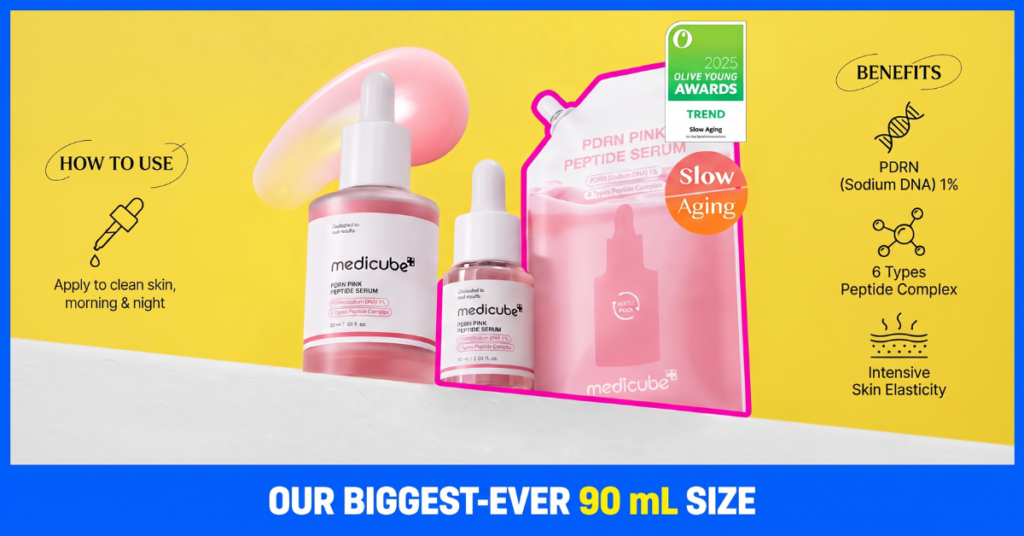
If your For You Page has turned into a shrine of glass skin transformations, you’ve already met the tiny pink bottle sending K-beauty forums into a frenzy: the medicube PDRN Pink Peptide Serum. Between the salmon DNA headlines and the “10,000ppm” flex printed right on the box, this ampoule has become the unofficial mascot of Korea’s regenerative skincare wave — and it’s finally having its moment with global shoppers. At WEMMERCE, we don’t just chase viral labels — we read the ingredient deck. So we pulled apart what PDRN actually is, why medicube paired it with a five-peptide complex, and whether this serum earns a permanent spot in your routine or is simply riding the salmon-sperm-extract news cycle. Let’s get into it. This isn’t medicube’s first viral hit — the brand has already built a global reputation through its Zero Pore Pad and Age-R Booster Pro device, both of which turned “Korean dermatology-inspired” into a household phrase for English-speaking skincare fans. The PDRN Pink Peptide Serum continues that same playbook: take a treatment normally reserved for in-clinic procedures, translate the science into a stable topical formula, and package it in a way that feels approachable rather than intimidating. That’s precisely why it’s worth a closer, ingredient-first look before you add it to cart. The PDRN Trend: Why Korea Is Obsessed With “Salmon DNA” Skincare PDRN stands for Polydeoxyribonucleotide — a purified DNA fragment, most commonly derived from salmon milt (Milt Extract, which you’ll spot on the ingredient list). It started its career in Korean dermatology clinics, used in injectable “salmon skin boosters” to accelerate tissue repair after laser treatments. Naturally, K-beauty labs did what they do best: they took a clinical-grade active and reformulated it for at-home topical use. Here’s the science in plain terms: PDRN works as a cell-communicating ingredient. It signals fibroblasts — the cells responsible for producing collagen and elastin — to ramp up repair and regeneration activity. Clinically, it’s associated with: Improved skin elasticity and firmness over time Faster-looking recovery for a dull, tired, or stressed complexion Support for the skin barrier’s natural repair cycle A visibly bouncier, more “cushiony” skin texture This is the ingredient that quietly powered Korea’s rise as a biotech-driven beauty hub — the same country that gave the world snail mucin and centella asiatica is now exporting DNA-repair science in a $30 bottle. Global search interest for “PDRN skincare” and “salmon DNA serum” has climbed steadily as TikTok dermatologists and K-beauty retailers like Olive Young spotlight it as the successor to retinol-fatigued routines: an active that focuses on repair and resilience rather than aggressive exfoliation. This shift mirrors a broader movement happening across the entire K-beauty export market right now. Where the last global wave was defined by glass-skin hydration (think snail mucin, hyaluronic acid multi-layering) and the wave before that by gentle chemical exfoliation (PHA, mandelic acid), 2025–2026 is shaping up to be the era of biotech and regenerative actives: PDRN, exosomes, growth-factor complexes, and fermented peptide serums. Korean labs have a decades-long head start in this space because so many formulas originate from — or are co-developed alongside — dermatology clinics, not just cosmetic chemistry departments. That clinical pedigree is exactly why global buyers are willing to pay a premium for Korean-formulated PDRN over generic alternatives. PDRN vs. Retinol vs. Collagen: What’s the Difference? Shoppers new to PDRN often ask how it compares to the anti-aging actives they already know. Here’s the honest breakdown: PDRN vs. Retinol: Retinol accelerates cell turnover and can cause purging, dryness, or sun sensitivity during the adjustment period. PDRN works through a different mechanism — cell signaling rather than exfoliation — so it typically comes with far less irritation, making it a strong option for those who can’t tolerate retinoids or want a gentler entry point into anti-aging skincare. PDRN vs. Topical Collagen: Collagen molecules applied topically are generally too large to penetrate deeply; they mostly sit on the surface providing temporary plumping and moisture-barrier support. PDRN, by contrast, is thought to work at a deeper cellular level, encouraging the skin to support its own collagen and elastin production rather than simply supplying a temporary surface film. PDRN vs. Peptides alone: Peptides and PDRN are complementary, not competing — which is exactly why medicube combined them. Peptides act as messengers that trigger specific repair pathways, while PDRN provides the broader regenerative signal. Used together, as in this formula, they reinforce the same collagen-elastin support system from two angles. Not Just PDRN: The “Pink Peptide” Half of the Formula medicube didn’t stop at PDRN. The “Pink Peptide” naming refers to a five-peptide complex layered into the formula — including Copper Tripeptide-1, Acetyl Hexapeptide-8, Palmitoyl Pentapeptide-4, Palmitoyl Tripeptide-1, and Palmitoyl Tetrapeptide-7. Peptides are short chains of amino acids that act as messengers, reinforcing the same collagen-signaling pathway that PDRN activates. Pair that with Hydrolyzed Collagen, Sodium Hyaluronate, and Niacinamide for hydration and tone-evening, and you get a formula built around one core idea: skin that looks like it repaired itself overnight. Full Review: medicube PDRN Pink Peptide Serum The version currently trending globally is the medicube PDRN Pink Peptide Serum 30ml + 50ml Refill Set — a smart packaging move that immediately signals this is meant to be a long-term staple, not a one-off trial purchase. Packaging & First Impressions The set arrives as a 30ml core bottle paired with a 50ml refill pouch — a format that’s becoming a signature move for Korean skincare brands trying to reduce packaging waste while offering better value per use. The pump bottle is opaque, which helps protect the light-sensitive actives inside, and the soft pink color-coding makes it instantly recognizable on a crowded vanity shelf. It’s a small detail, but the refill system also means you’re not paying for a brand-new outer bottle every time you repurchase, which noticeably improves the cost-per-milliliter over a full year of use. Texture & Sensorial Experience The serum has a lightweight, faintly pink-tinted gel-cream texture that sinks in without pilling —
Anua Collagen Retinol Gua Sha Cream: 7 Best Results (2026)
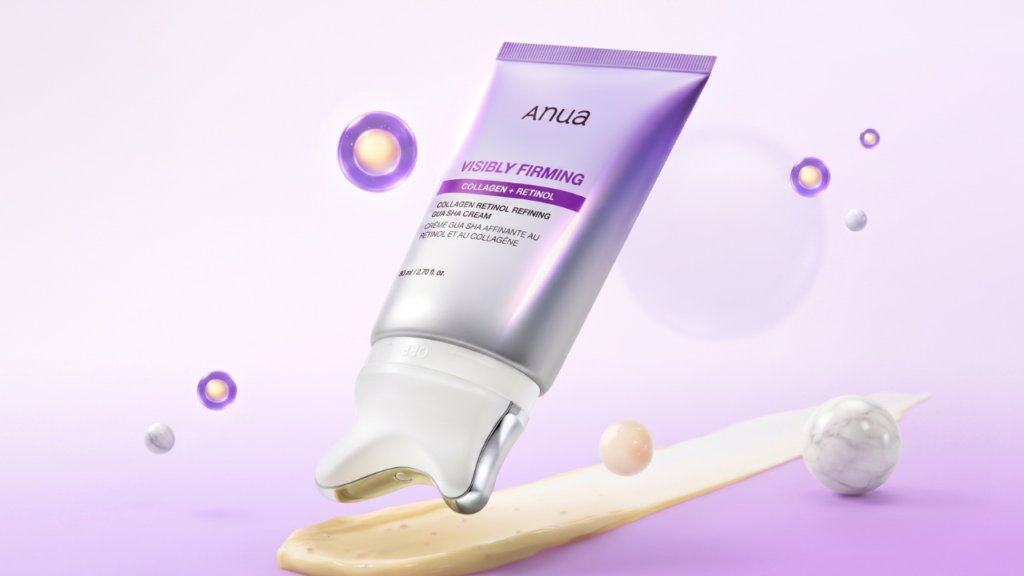
Anua Collagen Retinol Gua Sha Cream Review: The 2-in-1 Neck Firming Tool K-Beauty Is Obsessed With If you’ve spent any time on K-beauty TikTok this year, you’ve seen it: a cream that doubles as a massage tool, gliding along the jawline in that unmistakable “gua sha glide.” The Anua Collagen Retinol Refining Gua Sha Cream is the product behind the trend, and it’s quietly become one of Olive Young’s most talked-about launches for a reason that goes beyond the viral factor. It pairs an encapsulated retinol-and-collagen formula with a built-in massage applicator, targeting the neck, jawline, and décolleté — the zone most Western skincare routines quietly ignore. At WEMMERCE, we dug into the ingredient list, the clinical testing data, and real usage notes to see whether this is a genuine skincare innovation or just a satisfying-to-use gimmick. Here’s our full editorial breakdown. The K-Beauty Science Behind the Formula Korean formulation labs have a distinct approach to anti-aging: instead of leaning on a single hero ingredient, they build layered systems where actives, barrier-support lipids, and delivery technology work together. The Anua Collagen Retinol Gua Sha Cream is a clear example of that philosophy, and its full INCI list reveals a genuinely considered structure rather than a marketing-first formula. Encapsulated Retinol, Built for Thin Neck Skin Neck and décolleté skin is thinner and has fewer oil glands than facial skin, which is exactly why retinol products formulated for the face often over-irritate this area. Anua uses an encapsulated retinol delivery system, which slows the release of the active ingredient into the skin. The trade-off is gentler, more gradual results rather than a fast, aggressive resurfacing effect — which is the correct trade-off for this delicate zone. Hydrolyzed Collagen and a Peptide-Adjacent Complex Hydrolyzed collagen sits mid-list in the formula, working alongside adenosine — a cell-communicating ingredient well documented for supporting the look of firmness and smoothing fine lines. Collagen molecules are too large to penetrate deeply into skin, but as a surface-conditioning and moisture-binding ingredient, hydrolyzed collagen helps the skin feel plumper and more supple immediately after application, which is part of why the cream feels so satisfying during the gua sha massage step. A True Barrier-Support Lipid Layer This is where the formula distinguishes itself from a typical Western retinol cream. Cholesterol, Brassica Campestris (Rapeseed) Sterols, squalane, and hydrogenated lecithin form a skin-identical lipid complex modeled on the skin’s own barrier composition. Layered with panthenol and niacinamide, this complex is designed to buffer retinol-related dryness — an intentional counterbalance rather than an afterthought. Niacinamide, Coptis Japonica Root, and Chamomile Oil Niacinamide supports tone-evening and works synergistically with retinol’s cell-communicating action. Coptis Japonica Root Extract, a traditional Korean botanical, contributes antioxidant and soothing properties. Chamomilla Recutita (Matricaria) Flower Oil is included for its calming reputation — though as a fragrant plant oil layered with a retinoid, it’s the one ingredient combination that deserves a closer look if your neck skin tends to react easily (more on that below). Our Review: Does the Gua Sha Cream Actually Firm Skin? The neck and jawline have quietly become K-beauty’s next frontier. Between the rise of “tech neck” from constant phone and laptop use and a global shift toward preventative, contour-focused skincare, Korean brands have moved fast to fill a gap that most international skincare lines still overlook. Anua’s approach — pairing an at-home massage tool directly onto the cream packaging — removes the biggest barrier to a consistent gua sha habit: remembering to actually pick up a separate stone tool. According to the brand’s in-house testing over a two-week consistent-use period, users saw measurable changes: Jawline elasticity improved by 2.48% Neck elasticity improved by 2.53% Skin hydration improved by 132.61% Neck deep-set lines improved by 26.71% Neck fine lines improved by 19.62% Visible chin lift improved by 1.41cc In terms of texture, the Anua Collagen Retinol Gua Sha Cream is a genuinely rich cream — thick enough to give the applicator real “slip” for a smooth massage glide, but formulated to sink in without pilling, even when layered under other night products. It absorbs into a soft, cushioned finish rather than a greasy film, which matters for a product meant to double as a five-minute daily ritual rather than a one-time treatment. Who This Cream Is Best For Dry, normal, and mature skin tend to see the most benefit — the lipid-rich texture and barrier-support ingredients pair naturally with retinol’s tendency to dehydrate. Combination skin generally tolerates it well too, especially since the product is intended for the neck and jawline rather than the more oil-prone T-zone. If tech neck, a softening jawline, or décolleté crepiness are your main concerns, this formula was built specifically for that job. Who Should Proceed With Caution Sensitive or reactive skin should patch-test carefully, since the fragrant chamomile oil layered with a retinoid is a combination that can trigger sensitivity in reactive neck skin. As with any retinol product, it is not recommended during pregnancy or breastfeeding, and morning use should always be followed by SPF, since retinol increases sun sensitivity. This cream also pairs naturally into a broader neck-and-eye anti-aging routine. If you’re already building out that lineup, our Medi-Peel Red Lacto Collagen Eye Patch review covers a great complementary step for the delicate under-eye area, and if your neck skin needs a hydration reset before introducing retinol, our Eqqualberry Swimming Pool Toner review is worth a read for prepping the skin barrier. How to Use the Anua Gua Sha Cream Correctly Getting the technique right with the Anua Collagen Retinol Gua Sha Cream matters as much as the formula itself. Here’s the routine we recommend for best results: Cleanse first. Always start with a clean face and neck so the actives can absorb properly. Apply generously. Dispense the cream and apply it across the jawline, neck, and décolleté — this is a richer, more product-heavy step than a typical face cream. Activate the applicator. Use the built-in gua sha head to massage in upward, outward strokes
MEDI-PEEL Red Lacto Collagen Eye Patch Review: The Fermented Collagen Secret Behind K-Beauty’s Favorite Eye Fix.
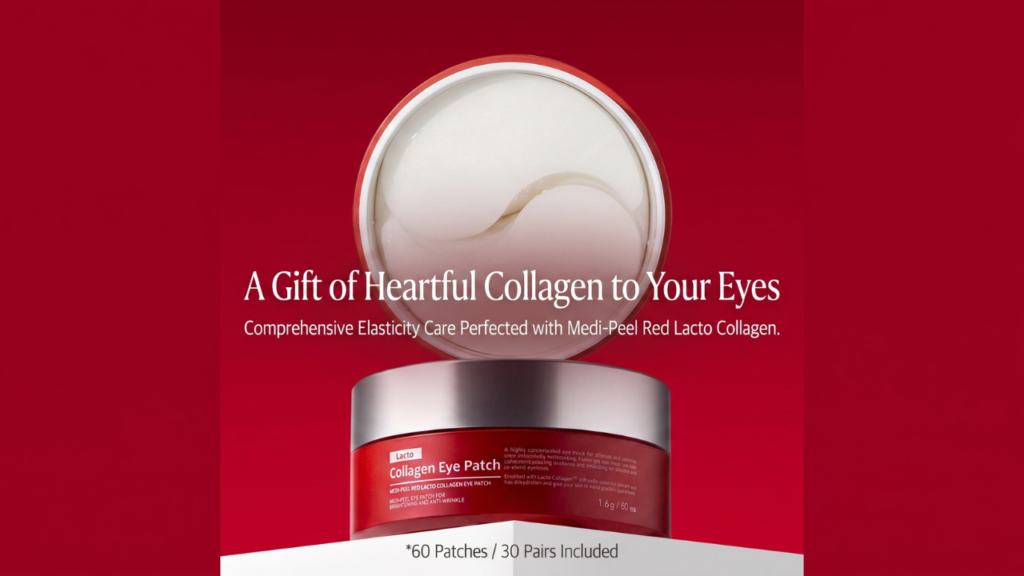
MEDI-PEEL Red Lacto Collagen Eye Patch Review: The Fermented Collagen Secret Behind K-Beauty’s Favorite Eye Fix If there’s one area of the face that gives away a late night, a long flight, or one too many hours staring at a screen, it’s the under-eye. Korea’s skincare labs have spent years engineering solutions for exactly this problem, and few brands have tackled it with as much scientific ambition as MEDI-PEEL — the derma-focused label beloved for its “high-functionality” homecare formulas. Today we’re putting the MEDI-PEEL Red Lacto Collagen Eye Patch under the microscope: what’s actually in it, who it’s for, and why it’s become a quiet cult favorite among Olive Young shoppers. Beauty disclaimer: individual results vary based on skin type, routine, and consistency of use. We always recommend a patch test on the inner arm 24 hours before applying any new product near the eye area. The Trend: Why Fermented Collagen Is Dominating K-Beauty Right Now The MEDI-PEEL Red Lacto Collagen Eye Patch didn’t appear out of nowhere — it’s the eye-area extension of a fermentation trend reshaping K-beauty formulation across the board. Korean R&D labs have moved past “just add collagen” formulations. The current trend — and the philosophy behind MEDI-PEEL’s Red Lacto Collagen line — is fermentation technology. Ingredients like bifida ferment and lactobacillus ferment lysate are cultivated the same way probiotic skincare pioneers first popularized years ago, but now they’re being paired with hydrolyzed collagen to create molecules that are smaller, more stable, and easier for skin to actually use. Here’s the science in plain terms: fermentation breaks down collagen peptides into smaller fragments and generates beneficial byproducts (amino acids, postbiotics) along the way. Smaller fragments sit better on the skin surface, layer more comfortably under an eye cream, and support the skin’s own barrier function — which matters enormously in the eye area, where skin is up to five times thinner than the rest of the face and has virtually no oil glands of its own. What’s Actually Inside the MEDI-PEEL Red Lacto Collagen Eye Patch True to the Red Lacto Collagen line’s signature complex, the MEDI-PEEL Red Lacto Collagen Eye Patch is built around a trio of technologies: Fermented collagen complex (bifida and lactobacillus ferment lysates plus hydrolyzed collagen) to visibly firm and hydrate the delicate under-eye area Hyaluronic acid and humectant carriers like glycerin and betaine that pull moisture into the skin and keep the patch adhered and cooling during wear Peptide and amino acid support (the same amino-acid building blocks — glycine, proline, arginine — found across the Red Lacto Collagen family) to reinforce the skin’s own structural proteins over time Because formulas are periodically updated, always double-check the full ingredient list on the product packaging or official Olive Young listing before purchase, especially if you’re managing a known allergy or sensitivity. A Quick Glossary: What These Ingredient Names Actually Mean K-beauty ingredient lists can look intimidating at first glance, so here’s a simple breakdown of what’s doing what in a formula like this: Bifida/Lactococcus/Lactobacillus ferment lysate: These are the “postbiotic” byproducts left behind after beneficial bacteria strains ferment a nutrient medium. They’re prized in Korean formulation for skin-conditioning and barrier-supporting properties, without the live bacteria itself being present in the final product. Hydrolyzed collagen: Collagen that has been broken down into smaller peptide fragments through hydrolysis. This doesn’t rebuild the collagen network deep in the dermis the way an in-office treatment might, but topically it functions as an effective humectant and film-former, helping the skin surface look plumper and feel more supple immediately. Sodium hyaluronate / hyaluronic acid: A moisture-binding molecule that can hold significantly more water than its own weight, making it a staple humectant in nearly every modern K-beauty formula, including eye patches. Niacinamide: Vitamin B3 in cosmetic form — included across much of the Red Lacto Collagen range to support barrier strength and even out the look of the skin over time. Amino acids (glycine, proline, arginine, and similar): The literal building blocks of collagen and elastin. Including free-form amino acids alongside hydrolyzed collagen is a common K-beauty formulation strategy to support the skin’s own protein synthesis pathways. Understanding this vocabulary is genuinely useful beyond this one product — once you can read a K-beauty ingredient list confidently, you’ll start noticing which “trend” ingredients are backed by real formulation science versus which ones are mostly marketing. Who Should Add This to Their Routine Eye patches aren’t one-size-fits-all, and the MEDI-PEEL Red Lacto Collagen Eye Patch is no exception. Here’s how it tends to perform across different skin profiles: Dry or dehydrated skin: The humectant-rich, collagen-forward formula is a strong match — expect a plumper, more cushioned look immediately after removal. Normal/combination skin: Works well as a 2–3x weekly reset, especially before events or after a poor night’s sleep. Sensitive skin: The fermented ingredients tend to be gentler than raw actives, but because this is an eye-area product, we still recommend a patch test — apply a small piece to the inner forearm and wait 24 hours before your first full use. Mature skin focused on firmness: Consistent use (2–3x weekly over 4–8 weeks) is where collagen-support formulas like this tend to show their best cumulative results — patience is part of the process. One important expectation to set: an eye patch is a hydrating, plumping, cosmetic treatment — not a medical or permanent solution for wrinkles or under-eye bags. Think of it as instant refreshment with a supportive, longer-term skin-conditioning benefit, not a substitute for retinol, sun protection, or a dermatologist’s guidance on deeper concerns. How It Compares to Other Under-Eye Formats Korea’s eye-care category spans several formats, and it helps to know where a fermented collagen patch fits: Vs. hydrogel-only patches: Plain hydrogel patches deliver mostly water and a cooling sensation. A collagen-and-ferment patch like this one layers active ingredients into that same cooling delivery system, so you get the sensory benefit plus a functional skincare payload. Vs. eye creams: Eye creams are built for daily, long-term
EQQUALBERRY Swimming Pool Toner Review: The Enzyme Toner Redefining Gentle Exfoliation in K-Beauty
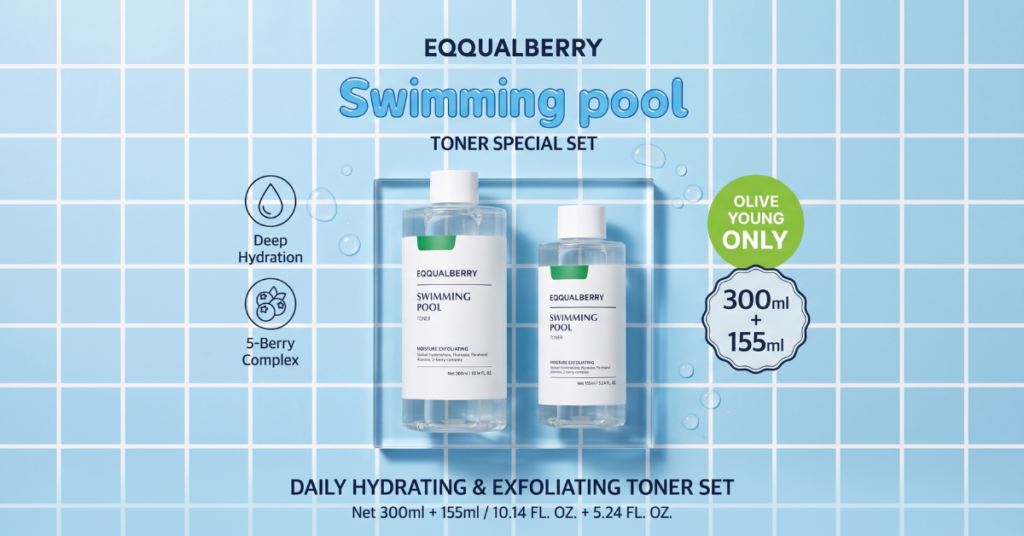
EQQUALBERRY Swimming Pool Toner Review: The Enzyme Toner Redefining Gentle Exfoliation in K-Beauty There’s a reason the K-Beauty world keeps circling back to one particular bottle with a swim-cap-pink label. The EQQUALBERRY Swimming Pool Toner has quietly become one of Korea’s most-repurchased exfoliating toners, and it isn’t relying on trend-chasing marketing to get there. It’s built on a genuinely different approach to resurfacing skin — one that swaps out the acids most of us are used to for something gentler, and arguably smarter. At WEMMERCE, we’ve been tracking which Olive Young bestsellers actually earn their reputation versus which ones ride a viral wave and fade. This one belongs firmly in the first category. Below, we’re breaking down exactly what’s inside the formula, how it compares to traditional AHA/BHA toners, who it’s suited for, and how to work it into a routine — plus where to buy it at the best price for your location. The Ingredient Science: Why Enzymes Instead of Acids? Korean skincare has spent the last several years refining a philosophy that Western routines are only recently catching up to: exfoliation doesn’t have to mean irritation. Where a glycolic or salicylic acid toner works by dissolving the “glue” between skin cells through a chemical acid reaction, the Swimming Pool Toner relies on protease, a naturally derived enzyme that breaks down dead skin cell buildup on a more surface-level, targeted basis. The practical difference is significant: enzymes tend to be far less likely to trigger redness, stinging, or the “purging” period many acid users experience when starting a new exfoliant. That’s the headline ingredient, but it’s far from the only one doing work here. The full formula includes: Protease enzyme — the gentle exfoliating agent at the core of the formula, used in place of AHA/BHA acids Sodium Hyaluronate (and a multi-molecular-weight hyaluronic acid blend) — draws moisture into the skin and helps it stay there, rather than evaporating within minutes A five-berry antioxidant complex — cranberry (Vaccinium Macrocarpon), blueberry (Vaccinium Angustifolium), raspberry (Rubus Idaeus), blackberry (Rubus Fruticosus), and elderberry (Sambucus Nigra), which contribute polyphenols and flavonoids that help counter everyday environmental stress on skin Panthenol (Pro-Vitamin B5) — calms and supports the skin barrier while it’s being gently resurfaced Allantoin and Beta-Glucan — soothing, barrier-reinforcing ingredients that reduce the likelihood of reactivity Euterpe Oleracea (Açaí) Fruit Extract — an additional antioxidant boost layered into the berry complex The formula is also low-pH, meaning it’s designed to sit close to skin’s natural acidity after cleansing — an important but often overlooked detail, since many Western-style toners and cleansers skew alkaline and can leave the skin barrier compromised. It’s alcohol-free, paraben-free, and formulated to be usable daily rather than as an occasional treatment. Texture, Scent, and First Impressions One thing that surprises first-time users: this isn’t a thin, watery toner. The texture sits somewhere between a traditional toner and a light essence — noticeably more cushioned on the skin, but still fast-absorbing with zero tackiness left behind. That in-between consistency is part of why it works so well as a hydration step and not just an exfoliation step; it has enough body to actually deposit hyaluronic acid into the skin rather than evaporating off the surface immediately. Who Should Add This to Their Routine? This toner earns its “for all skin types” label more honestly than most. Here’s how it tends to perform by concern: Sensitive or reactive skin: The enzyme-over-acid approach, combined with panthenol and allantoin, makes this one of the few daily exfoliants that sensitive-skin users can genuinely tolerate long-term. Textured, bumpy, or congested skin: Gradual enzymatic exfoliation helps smooth rough patches and minimize the look of clogged pores without the “sandpaper” feeling some physical scrubs leave behind. Dehydrated or dry skin: The layered hyaluronic acid content makes this function as a genuine hydration step, not just a prep product. Acne-prone skin: Because it avoids harsh surfactants and alcohol, it’s less likely to disrupt an already-compromised barrier — though, as with any active, patch-testing is still recommended. Glass-skin seekers: The combination of gentle resurfacing and deep hydration is exactly the one-two punch behind that smooth, light-reflecting finish K-Beauty is known for. How to Use the Swimming Pool Toner This toner works into a routine as the very first step after cleansing, before serums, essences, or moisturizer. There are three ways to apply it, depending on your skin’s needs that day: 1. Cotton Pad Method (Best for Exfoliation Focus) Soak a cotton pad and sweep it gently across the face and neck. Repeat two to three passes to lift away residual impurities and loosened dead skin cells left behind after cleansing. 2. Hand-Press Method (Best for Hydration Focus) Pour a small amount into clean hands and press it into the skin in upward motions until fully absorbed. This method delivers more product into the skin and is gentler on days when skin feels more reactive. 3. Ten-Minute Mask Method (Best for a Hydration Reset) Soak a cotton pad generously and leave it resting on drier or dull-looking areas for about ten minutes. This turns the toner into a quick hydration mask and is a favorite trick before makeup application or after a long flight. Beauty disclaimer: As with any new active ingredient — including enzyme exfoliants — we recommend patch-testing on a small area of skin before full facial application. Individual results vary based on skin type, climate, and existing routine. How It Fits Into the Bigger K-Beauty Trend The rise of enzyme-based exfoliants mirrors a broader shift happening across Korean skincare right now: formulas are being engineered to deliver visible results while actively protecting the skin barrier, rather than treating “results” and “gentleness” as a trade-off. It’s the same philosophy driving the popularity of low-pH cleansers, barrier-repairing ceramide creams, and centella-based soothing lines that dominate Olive Young’s bestseller shelves. The Swimming Pool Toner fits neatly into that story — it’s less a single hero product and more a case study in where K-Beauty formulation is heading globally.
Tried the OFRA Cosmetics Mini Highlighter Set — Here’s My Honest Take.
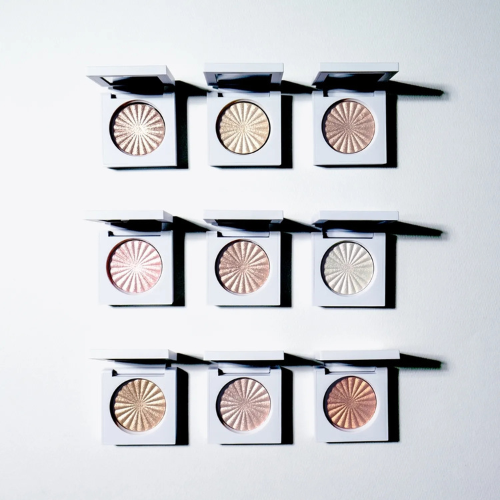
I Tried the OFRA Cosmetics Mini Highlighter Set — Here’s My Honest Take A real, no-filter review after two weeks of daily wear I’ve been curious about the “Idol’s Must-Have” OFRA Mini Highlighter for a while — it kept showing up in beauty hauls and Olive Young Global bestseller lists, so I finally picked one up to test for myself. This isn’t a sponsored puff piece. It’s a genuine breakdown of what happened when I actually used it on my skin, morning and night, for two straight weeks, across different weather, lighting, and makeup looks — from bare-faced errands to a full glam night out. I’ll admit I went in a little skeptical. I’ve been burned before by “viral” highlighters that photograph beautifully but turn chalky, patchy, or overly glittery the moment they’re on actual skin instead of a swatch card. So my testing wasn’t just “does it look nice in the pan” — it was “does it survive a real day, on real skin, under real lighting.” Here’s everything I noticed. First Impressions: Packaging & Presentation The mini highlighter arrives in a compact, travel-friendly compact — small enough to toss into a makeup pouch without adding bulk. Olive Young Global lists OFRA Cosmetics as a verified brand partner on their platform, so I wasn’t worried about authenticity when it arrived — the packaging matched official product photos exactly, down to the embossed logo on the lid. The compact itself has a solid, satisfying weight to it — not flimsy plastic that flexes when you press on it, which matters more than people think for a product that’s going to live in a bag and get tossed around. The mirror inside is small but functional for quick touch-ups, and the hinge felt secure through two weeks of opening and closing multiple times a day. What struck me first was the pan size. Because it’s the “mini” version, the amount of product is smaller than OFRA’s full-size highlighters, but for someone who only needs a light dusting on the cheekbones, that’s honestly a plus — less product going to waste, and it’s easier to finish a pan before it dries out or gets contaminated with old brush hairs. If you’re someone who rotates through a lot of makeup and rarely finishes a full-size highlighter before it starts looking a bit worn out, the mini format actually makes more practical sense than it might seem at first glance. Texture & First Swatch Test I swatched three of the ten available shades on the back of my hand before touching my face. The formula is a pressed powder, and it’s noticeably finely milled — when I ran my finger across it, there was almost no kick-up of loose powder, which is a good sign for anyone who’s dealt with fallout from cheaper highlighters landing all over their under-eye concealer. Pigment payoff: One light tap of the brush gave a soft glow; two taps built to a noticeably more intense sheen. Texture on skin: Smooth, almost silky, not chalky or dry-looking. Blendability: Melted into my base makeup with a fluffy brush in just a couple of strokes — no harsh lines. How It Looks in Different Lighting Something I always test with highlighters is how the finish changes depending on light source, because a product that looks stunning under a ring light can sometimes look completely different under office fluorescents or natural daylight. Natural daylight: The glow read as soft and slightly wet-looking, in a good way — not overly sparkly. Indoor/warm lighting: This is where it looked its best to me — the pink-gold undertone really came through and gave a lit-from-within quality. Camera flash / photos: Showed up clearly without blowing out or looking like glitter chunks in photos, which I appreciated for anyone who takes a lot of selfies or content photos. How It Compares to Other Highlighters I’ve Used To give this review some real context, I compared it against two other highlighters currently in my collection — one drugstore option and one higher-end powder highlighter from a different brand. Compared to the drugstore option, the OFRA mini felt noticeably softer and more finely milled on application, with less obvious glitter particles and a more “your skin but better” effect rather than an obvious sparkle. Compared to the higher-end highlighter, the pigment payoff was fairly similar, though the OFRA formula blended slightly more easily with a fluffy brush, likely because the mini pan encourages a lighter, more controlled application by nature of its smaller surface area. Where it didn’t quite match the pricier option was in longevity on my oilier T-zone — the higher-end highlighter held its exact original finish a bit longer before shifting. That said, the difference wasn’t dramatic, and for the price point and travel-friendly size, I think the trade-off is reasonable. How It Performed on My Skin Type I have combination skin — oily through the T-zone, drier around my cheeks — so I tested this over roughly ten wears in different conditions to get a realistic sense of how it holds up. Dry / Normal Areas On the drier parts of my cheeks, the highlighter sat beautifully. It didn’t cling to any dry patches or emphasize texture, which is something I’ve had issues with in the past using overly shimmery powders. The finish read as a soft, lit-from-within glow rather than glitter. Oily Areas By hour six or seven, especially on warmer days, the highlight on my cheekbones did shift slightly — it got a touch more intense as my natural oils mixed with the product, giving a dewier (some might say “wetter”) look than the initial application. Personally I didn’t mind it, but if you have very oily skin and prefer a strictly matte-adjacent glow all day, you may want to set it with a light dusting of translucent powder around the high points. Longevity Wear time landed around 7–8 hours before I felt the need to touch up, which is respectable for
30-Second Glass Skin: Why MENOKIN’s Bubble Mask Is K-Beauty’s Fastest Glow-Up Yet.
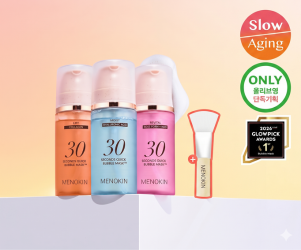
Korean Beauty Innovation, Delivered to Your Door 30-Second Glass Skin: Why MENOKIN’s Bubble Mask Is K-Beauty’s Fastest Glow-Up Yet If you’ve spent any time scrolling through K-beauty TikTok or Korean skincare forums lately, you’ve probably seen the term “glass skin” thrown around constantly. That dewy, luminous, almost translucent complexion that seems to defy logic isn’t just a filter trick — it’s a real result of Korea’s relentless innovation in skincare formulation. And right now, the product everyone in Seoul’s beauty circles is buzzing about is the MENOKIN 30 Seconds Quick Bubble Mask Set. Unlike traditional sheet masks that ask you to sit still for 15–20 minutes (who has time for that on a Tuesday morning?), this bubble mask set promises visible glow in literally half a minute. No rinsing. No waiting. Just clean, plump, radiant skin before your coffee even finishes brewing. At WEMMERCE, we’ve made it our mission to bring genuinely innovative Korean formulas like this to skincare lovers outside of Korea — and the MENOKIN 30 Seconds Quick Bubble Mask Set earns its spot at the top of our recommendation list. The K-Beauty Trend Behind “Leave-On” Bubble Technology For years, the global skincare conversation was dominated by multi-step routines — the famous 10-step Korean ritual that involves double cleansing, multiple toners, essences, ampoules, and sheet masks. While that approach still has its devoted fans, Korea’s beauty labs have been quietly developing something different: technology that compresses multi-step benefits into single, ultra-fast applications. This is where Micro-Bubble Capsule™ technology comes in. Rather than relying on a thick sheet soaked in serum (which takes time to fully transfer actives into skin), MENOKIN engineered an airy, ultra-fine bubble texture that’s designed to penetrate pores almost instantly. The micro-bubbles essentially act as tiny delivery vehicles, carrying active ingredients deep into the skin barrier within seconds rather than minutes. This “leave-on, no-rinse” format is becoming one of the biggest movements in Korean skincare for 2026. Busy professionals, students, and anyone juggling a hectic schedule are gravitating toward products that respect their time without sacrificing the results Korean skincare is famous for. Why Korean Formulation Still Leads the Industry It’s worth pausing here to talk about why Korean skincare brands continue to out-innovate much of the global market. Korea’s cosmetic R&D ecosystem is supported by some of the strictest ingredient safety regulations in the world, combined with a culture that treats skincare almost like a science — constantly testing molecular weights, absorption rates, and ingredient stability under different climate conditions. You simply don’t find this level of formulation precision replicated outside Korea. It’s part of the reason why products like MENOKIN’s bubble mask can’t be picked up at your average Western drugstore, or even on platforms like Amazon or Sephora — they’re developed specifically for the Korean domestic market and distributed primarily through trusted retailers like Olive Young Global, Korea’s largest health and beauty chain. Inside the Formula: The Ingredients That Make It Work What separates MENOKIN’s set from a typical “quick fix” product is the thoughtfulness behind its ingredient choices. The set is built around three targeted variations, each formulated to solve a different skin concern: LIFT — 300 Dalton Hibiscus Collagen: This isn’t your average collagen. Most collagen molecules are far too large to actually penetrate the skin — they simply sit on the surface. MENOKIN uses an ultra-low molecular weight, vegan-derived hibiscus collagen (just 300 Dalton in size) that’s small enough to travel deeper into skin layers, helping restore bounce and firmness to sagging or tired-looking contours. BRIGHT — Glutathione & Vitamin C: This brightening duo is a favorite combination among Korean dermatologists for a reason. Glutathione works at a cellular level to reduce the appearance of dark spots and dullness, while Vitamin C supports an even, “lit-from-within” radiance. Together, they tackle uneven texture and hyperpigmentation without harsh exfoliation. CLEAR & MOIST — Cica Exosomes + 8-Complex Hyaluronic Acid: If your skin barrier is feeling reactive, stressed, or dehydrated, this is the variation to reach for. Cica (Centella Asiatica) exosomes are one of the most talked-about ingredients in Korean dermo-cosmetics right now for their soothing, barrier-repairing properties, while the multi-molecular-weight hyaluronic acid complex hydrates at every skin layer — not just the surface. Each formula is also free from harsh fragrances, PEGs, and artificial colorants, making this set approachable even for sensitive or reactive skin types. Who Should Try the MENOKIN Bubble Mask Set? One of the things we love most about this set is its versatility. Here’s how it performs across different skin types and concerns: Dry or dehydrated skin: The CLEAR & MOIST formula’s multi-layered hyaluronic acid complex delivers deep, lasting hydration without any heaviness or stickiness — perfect for skin that typically feels tight by midday. Dull or uneven-toned skin: The BRIGHT formula’s glutathione and Vitamin C combination works to visibly even out tone and restore a healthy glow, especially helpful after sun exposure or fatigue. Mature or sagging skin: The LIFT formula’s ultra-penetrating collagen helps support firmness and elasticity, making it a smart addition to an anti-aging routine. Sensitive or irritated skin: Thanks to Cica exosomes and the fragrance-free, PEG-free formulation across the entire line, even reactive skin types can incorporate this set without worry. Busy mornings or makeup prep: Because it absorbs in seconds and leaves no residue, it’s an ideal step right before foundation — smoothing texture and giving your base a luminous, glass-skin finish. How to Use It: Your 30-Second Glass Skin Ritual The beauty of this product is in its simplicity. Here’s exactly how to use it for the best results: Cleanse and tone first. Make sure your skin is clean and slightly damp — this helps the micro-bubbles spread evenly. Dispense 2–3 pumps of your chosen MENOKIN formula directly onto your fingertips. Spread gently from the center of your face outward, following your skin’s natural contours. Massage lightly for 30 seconds until the micro-bubbles fully absorb — you’ll feel the texture transform from foamy to silky. Do not rinse. Move directly
Losy Kim TXA BB Essence: The K-Beauty Glass Skin Secret.
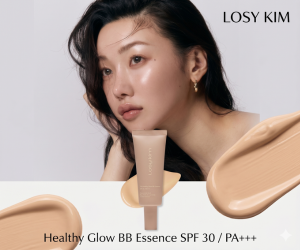
If you’ve spent any time scrolling through K-Beauty TikTok or Instagram lately, you’ve seen it: that impossibly smooth, lit-from-within “glass skin” finish that makes Korean skincare lovers look like they were never wearing makeup at all. No visible powder, no cakey texture, no obvious “base” — just radiant, even-toned skin that looks healthier the longer you wear it. The secret isn’t a 12-step routine or a clever filter. It’s a category of product that barely exists outside Korea, and it’s quietly replacing foundation for thousands of women around the world: the BB essence. Today we’re diving deep into one of the most talked-about releases from Korea’s beauty capital, Olive Young — the Losy Kim TXA Healthy Glow BB Essence — and unpacking exactly why it might be the last “base makeup” product you ever need to buy. We’ll cover the science behind the trend, who this formula is really for, how to apply it for maximum glow, and how it stacks up against the products you’ve probably already tried and been disappointed by. The Glass Skin Trend: Why Korea Stopped Wearing Foundation For decades, the global beauty standard was built around coverage — heavier foundation, more powder, more concealer, more “full glam.” Korea quietly built the opposite philosophy. The “glass skin” approach treats the base of your face as skincare first, makeup second. Instead of masking the skin for eight hours and then washing it all off at night with nothing gained, the goal is to actively treat the skin while you wear it, so your complexion genuinely improves with every use rather than just being hidden temporarily. This is where the BB essence category comes in, and it’s important to understand why it’s different from anything in a typical Western makeup bag. A traditional BB cream is essentially a lightweight foundation with a few skincare claims tacked on for marketing. A true BB essence, on the other hand, is formulated like a serum first and a makeup product second. It’s watery in texture, it sinks into the skin rather than sitting on top of it, and it’s loaded with active ingredients normally reserved for nighttime treatments — things like brightening acids, barrier-repairing humectants, and antioxidants. The result is a product category that simply doesn’t have a Western equivalent. You’re not “covering up” your skin in the traditional sense — you’re treating it while giving it a soft-focus, healthy-looking finish at the same time. That’s the entire premise of glass skin, and it’s why this trend has been so difficult for international brands to copy authentically. The Hero Ingredients Driving This Trend Tranexamic Acid (TXA): Originally used in dermatology clinics to treat melasma and stubborn pigmentation, TXA has become one of the biggest skincare crossover ingredients of the decade. It works by calming the pigment-producing pathways in the skin, gradually fading dark spots, post-acne marks, and sun damage — all while you’re simply going about your day wearing it as makeup. Niacinamide: A K-Beauty mainstay for a reason. It pairs beautifully with TXA to brighten dullness, visibly tighten the look of enlarged pores, and reinforce a weakened moisture barrier. It’s one of the few ingredients dermatologists and K-Beauty formulators agree on almost universally. Broad-Spectrum SPF: Korean formulators have mastered lightweight, non-greasy, non-whitening sun filters, which is why so many of these hybrid products can carry real SPF ratings without the chalky cast or heavy, sticky feel that’s so common in Western sunscreen-makeup hybrids. When you combine all three of these in a single product, you get something that brightens, blurs, hydrates, and protects — replacing three or four separate steps of a typical Western morning routine with one simple pump. That’s not just convenient; for a lot of people, it’s the difference between actually sticking to a skincare routine and abandoning it after two weeks because it felt like too much effort. Our Recommendation: Losy Kim TXA Healthy Glow BB Essence If you want to actually experience this trend rather than just read about it, the Losy Kim TXA Healthy Glow BB Essence (40ml) is one of the clearest examples of the category done right. It was formulated specifically around the idea that your “everyday makeup” shouldn’t undo the work of your skincare routine — it should extend it. What makes it stand out: A true skincare-makeup hybrid — not a heavy foundation in disguise Formulated with TXA + Niacinamide to actively fade dark spots and hyperpigmentation over time SPF 30 / PA+++ for daily UV defense Sheer, dewy, “second-skin” finish with zero cakey buildup 3 universally flattering neutral shades: Milk, Latte, and Toffee 24-hour wear with a fresh, hydrated glow — not the dry-down most BB creams give you by noon Who Will Love This Product Most? Skin type matters a lot with dewy-finish formulas, so here’s an honest, type-by-type breakdown so you know exactly what to expect before you buy: Dry or dehydrated skin: This is your dream formula. The dewy, hydrating finish sits beautifully on dry skin and helps it look plump, smooth, and healthy instead of flaky or tight. You’ll likely notice your skin looks better at the end of the day than it did in the morning. Normal/combination skin: Expect a natural, lit-from-within glow that lasts comfortably through the day without needing constant touch-ups. This is the skin type the formula was most broadly designed around. Oily or acne-prone skin: You’ll still love the brightening and blurring effect, but plan to set it with a light dusting of translucent powder on your T-zone if you want the glow to stay controlled rather than turning shiny by midday. The brightening benefits from TXA still apply regardless of oil level. Hyperpigmentation, melasma, or post-acne marks: Because of the TXA, this is genuinely one of the few “makeup” products on the market that’s also functioning as a brightening treatment with every single wear. Most people see other BB products as purely cosmetic — this one is doing double duty. How It Compares to a Traditional BB Cream
Why Your Foundation Never LooksThis Flawless — Until Now.
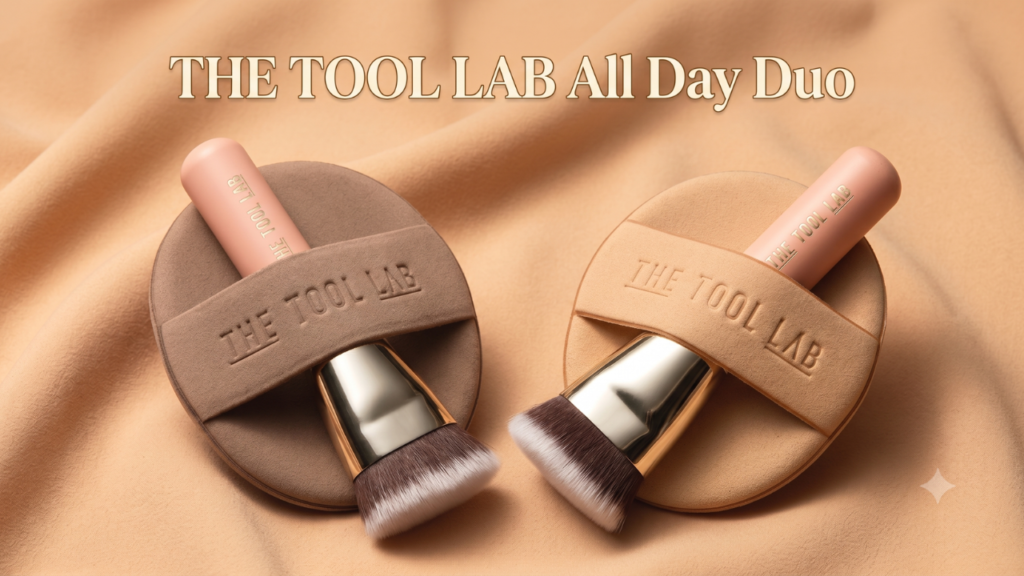
Olive Young Bestseller · Exclusive at Wemmerce Why Your Foundation Never LooksThis Flawless — Until Now The K-Beauty industry’s best-kept secret isn’t a serum. It’s the tool behind every glass-skin finish you’ve ever envied. Meet THE TOOL LAB All Day Duo — the Olive Young bestseller that’s quietly rewriting foundation rules worldwide. ⏱ 8 min read · Updated June 2026 Let’s be honest. You have probably spent more money than you’d like to admit on high-end foundations, viral cushion compacts, and Korean BB creams — only to stare into the mirror mid-afternoon wondering where your “flawless base” disappeared to. The pores are back. The texture is back. And somehow, mysteriously, so is the cakey patch along your jawline. Here’s what most of us skip right past: the formula is rarely the problem. The culprit, more often than not, is the application method — specifically, the tool you’re using to put that foundation on your face in the first place. Korean makeup professionals have known this for years. K-Beauty’s glass skin aesthetic — that luminous, pore-blurred, almost digital-looking finish — doesn’t come purely from ingredients. It comes from layering technique, and technique is only as good as the tools that execute it. That’s precisely why THE TOOL LAB All Day Duo has become one of Olive Young’s most talked-about makeup accessories, and why beauty editors across Seoul keep it within arm’s reach at every shoot. The Global Obsession with Glass Skin — And Why Your Tools Are Holding You Back The term “glass skin” didn’t emerge from nowhere. It was coined by Seoul-based beauty blogger Ellie Choi around 2017 and captured something the K-Beauty world had been quietly perfecting for decades: a complexion so uniformly smooth and luminously hydrated that it catches light the way polished glass does. No pores. No texture. Just a seamless, glowing canvas. The trend exploded globally, fueling a wave of interest in sheet masks, essence layers, and cushion foundations. But even beauty enthusiasts who religiously followed multi-step Korean skincare routines often found themselves frustrated. Their glass skin still looked… slightly frosted. A little streaky. Not quite there. The missing piece? Most people are applying their foundation with the wrong pressure, the wrong motion, and the wrong tool density. A standard beauty sponge absorbs product. A flat paddle brush drags. Even premium brushes, when used with the wrong technique, leave micro-ridges in the foundation that scatter light instead of reflecting it. ✦ K-Beauty Pro Insight: Korean makeup artists typically apply foundation in two distinct phases — a sweeping phase to distribute product, followed by a pressing phase to lock it into the skin. This dual-action approach is the foundation (no pun intended) of the all-day flawless finish, and it requires two different tool types working in tandem. THE TOOL LAB understood this principle at the product design level. Rather than selling a single tool and asking you to figure out the rest, they engineered the All Day Duo as an intentional two-step system: a precision brush for initial distribution, and a high-density Rubycell puff for the critical pressing and sealing phase. Together, they replicate what a professional makeup artist achieves in a studio — in your bathroom, in under three minutes. Inside the Duo: What Makes These Tools Genuinely Different Not all makeup tools are created equal. The beauty market is flooded with brushes and sponges that feel indistinguishable on the shelf but deliver wildly different results on the skin. Here’s what sets THE TOOL LAB All Day Duo apart from the crowd — and why it’s earned its Olive Young bestseller status rather than just inheriting it. ① The Precision Foundation Brush — Premium Tension Synthetic Bristles The brush component of the duo uses ultra-dense, premium synthetic bristles engineered with what THE TOOL LAB calls “tension technology.” Unlike natural hair brushes that fan out under pressure and deposit product unevenly, these bristles maintain their shape and density throughout every stroke. What this means in practice: you get a razor-thin, even film of foundation swept across your face in broad strokes without the bristles absorbing the product into the ferrule. Less waste, more coverage, zero streaking. The bristle construction also makes a significant difference for skin sensitivity. Standard bristles create micro-friction on the skin’s surface — imperceptible in the moment but cumulatively irritating for those with sensitized or breakout-prone skin. The ultra-soft fiber finish here is genuinely gentle, gliding over active blemishes and dry patches without aggravating either. ② The High-Density Rubycell Puff — K-Beauty’s Secret Weapon Rubycell is a Korean-developed foam material that has quietly become one of the most coveted textures in the K-Beauty tool world. It’s denser than standard beauty sponge material, more resilient, and critically — it does not absorb foundation the way conventional sponges do. When you tap a Rubycell puff loaded with product onto your skin, it presses the foundation into the pore rather than sitting it on top of the skin. This micro-pressing action is what locks the foundation against your face for an all-day, crease-resistant finish. It’s also the secret behind that second-skin feeling — the foundation doesn’t feel like it’s sitting on you, it feels like it’s part of you. The puff’s edge geometry is also worth noting. The slightly pointed shape at one end allows precise application around the nose creases, under the eyes, and along the hairline — zones where conventional round sponges inevitably leave a soft, unblended edge. With THE TOOL LAB puff, you can chase every contour of your face to full, seamless coverage. ③ The Ergonomic Natural Wood Handle This detail signals something important about THE TOOL LAB’s design philosophy: they didn’t cut corners on the handle to save cost. The natural wood is balanced and weighted to distribute pressure evenly from your fingers to the bristle tips, giving you the kind of controlled application where pressure variations don’t result in coverage streaks. It’s the difference between wielding a tool with intention and just pushing product around. Which Skin Type Benefits Most?
AHC Pro Shot Eye Cream For Face Review: The Viral Korean Lifting Cream That Actually Delivers.
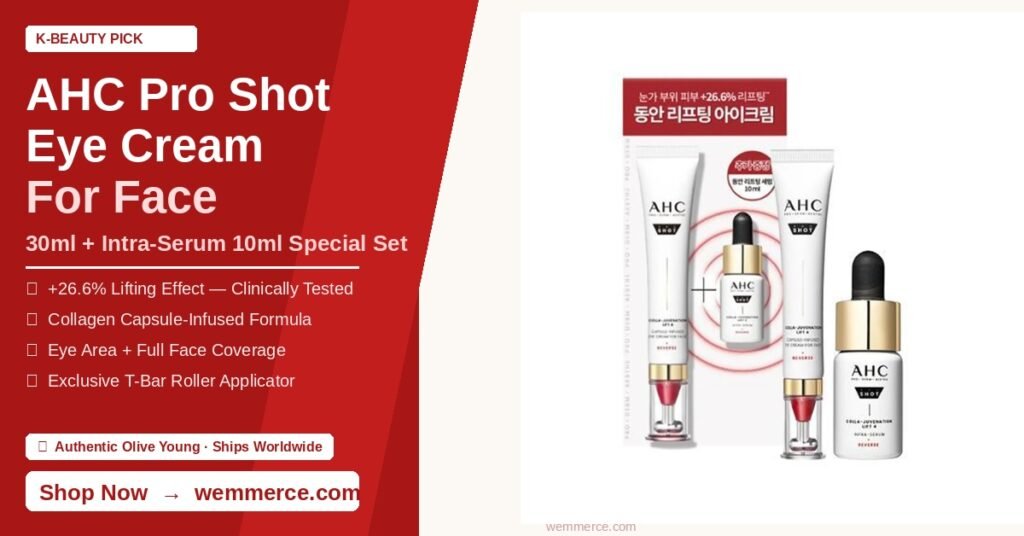
✦ K-Beauty Deep Dive · Wemmerce Curated AHC Pro Shot Eye Cream For Face Review: The Korean Lifting Cream That Actually Delivers If you have been scrolling through K-Beauty forums lately, one product keeps coming up: the AHC Pro Shot Colla-Juvenation Lift 4 Capsule-Infused Eye Cream For Face Special Set. Backed by a clinically tested +26.6% lifting effect and a collagen capsule formula built on 20+ years of dermaesthetic science, this is not your average eye cream — it is a full-face anti-aging treatment in a tube. In this review, we break down the science, the key ingredients, real-world application tips, and why the Special Set — which includes the 10ml Intra-Serum bonus — is the smarter buy for anyone serious about lifting and firming results. What Is AHC Pro Shot Eye Cream For Face? AHC (Aesthetic Hydration Cosmetics) has long been Korea’s go-to brand for professional-grade skincare at accessible prices. Their Eye Cream For Face concept — applying a high-potency eye cream across the entire face — became a global phenomenon because the formulas are genuinely powerful enough for full-face use. The newest chapter, Pro Shot Colla-Juvenation Lift 4 · REVERSE, pushes into serious anti-aging territory. It is designed as a clinic-level lifting and firming protocol you can do at home, twice a day. At a glance Brand: AHC (Aekyung Beauty Creator) Line: Pro Shot · Colla-Juvenation Lift 4 · REVERSE Set Contents: Eye Cream For Face 30ml + Intra-Serum 10ml Key Claim: +26.6% lifting effect around the eye area (clinically tested) Core Technology: Multi Layer Shot Liposome™ · PRO-RETI4 · 2% Collagen Capsule Skin Types: All skin types including sensitive Where to Buy: Exclusively at Wemmerce — not on Amazon or Sephora Why Collagen Capsule Technology Is Dominating K-Beauty in 2025 The global skincare conversation has shifted: it is no longer just about what is in your formula — it is about how deeply it actually reaches your skin. South Korean cosmetic labs have been leading this delivery-system revolution for years, and AHC’s Pro Shot line is the clearest proof yet. Multi Layer Shot Liposome™ — The Delivery Engine The star technology in AHC Pro Shot is the proprietary Multi Layer Shot Liposome™ system. Actives are synthesized to be 1,430 times smaller than a pore, bypassing the skin’s surface barrier and reaching the deeper layers where collagen production actually happens. This is the functional gap between a cream that sits on your skin and one that works inside it. PRO-RETI4 — Retinol, Reinvented Standard retinol is the gold standard for anti-aging — but it comes with a well-known downside: irritation, purging, and a lengthy adaptation phase. AHC’s answer is PRO-RETI4, a next-generation retinol derivative that penetrates skin layers faster than standard retinol while significantly lowering the risk of redness and sensitivity. Suitable for all skin types, including sensitive. 4-Type Human Collagen + 2.7× Richer Peptide Complex The formula contains 4 types of collagen mirroring the collagen structure found in human skin — a formulation developed over more than 20 years of dermaesthetic research. Layered on top is a 1% Peptide Complex of 4 different peptides calibrated to signal collagen production, at a concentration 2.7× richer than the previous AHC generation. The 2% Collagen Capsule acts as an instant filler — visible plumping from the very first use. Key Ingredients Breakdown PRO-RETI4 Advanced retinol alternative. Faster penetration, lower irritation. Ideal for sensitive skin and retinol beginners. 2% Collagen Capsules Instant visible plumping. Fills fine lines on contact. Sustained firming effect with continued daily use. 1% Peptide Complex (4 types) Boosts natural collagen production. 2.7× richer concentration. Targets elasticity loss and facial contour. Multi Layer Shot Liposome™ 1,430× smaller than pores. Delivers actives deep into skin layers that topical creams cannot reach. The T-Bar Roller Tip: Functional, Not Just Pretty The signature T-bar stainless steel roller tip on the Eye Cream tube is not a design gimmick. The cool metal roller: Reduces morning puffiness through cooling contact Promotes lymphatic drainage and microcirculation around the eye area Improves product absorption through gentle mechanical pressure Makes the application feel genuinely professional — like a spa treatment at home Roll across the undereye and temple area in an outward motion each morning and evening. Most users notice a visible difference in puffiness within the first week. Why the Special Set Is the Smarter Buy The Special Set pairs the 30ml Eye Cream with the Colla-Juvenation Lift 4 Intra-Serum (10ml). The serum is a primer layer — applied first to prep skin for maximum cream absorption. Together they create a two-step professional protocol: Two-step home lifting protocol 1 Apply Intra-Serum first Dispense 2–3 drops. Press gently across the face, eye area, and neck. Allow 30 seconds to absorb fully. 2 Layer the Eye Cream For Face Using the T-bar roller tip, apply in gentle upward strokes across the full face. Use morning and evening for maximum lifting effect. What the Clinical Data Shows South Korea’s Ministry of Food and Drug Safety (MFDS) classifies AHC Pro Shot as a wrinkle improvement functional cosmetic — meaning all efficacy numbers are government-regulated claims backed by clinical testing, not marketing copy. +26.6% Lifting effect around the eye area — clinically measured 4 Wks Visible wrinkle reduction including lines 3+ years old 1,430× Smaller than pores — depth actives reach via liposome tech Who Should Use This? ✦ Perfect for Ages 28+ looking for preventative lifting care Fine lines, crow’s feet, or sagging around eyes Sensitive skin that cannot tolerate standard retinol Anyone wanting full-face firming, not just eye treatment K-Beauty fans ready to step up from basic moisturizers ⚠ Keep in mind Patch test recommended for highly reactive skin Best results need consistent twice-daily use PRO-RETI4 increases photosensitivity — always use SPF in AM Full results visible at 4 weeks, not overnight How to Use — Step by Step 01 Cleanse and tone Apply on clean, prepped skin. The formula absorbs best after toning, when skin is still slightly damp. 02 Apply Intra-Serum (set users) Press 2–3
BIOHEAL BOH Probioderm 3D Lifting Cream Review: The Olive Young Bestseller That’s Redefining K-Beauty Anti-Aging.
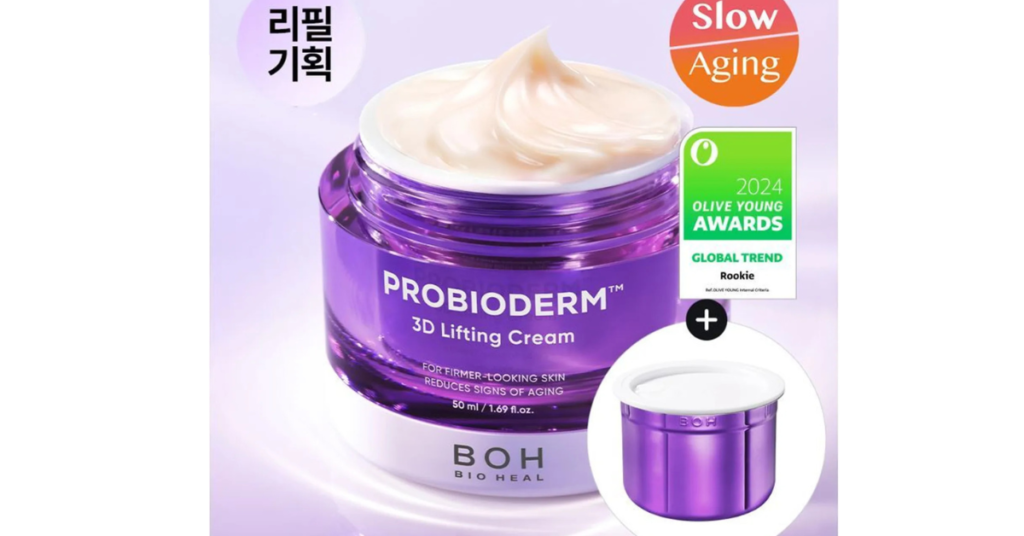
K-Beauty Skincare Review · Wemmerce BIOHEAL BOH Probioderm 3D Lifting CreamThe K-Beauty Secret to Firmer, Younger-Looking Skin If you’ve been searching for a probiotic-powered lifting cream that Korean beauty insiders swear by, your search ends here. The BIOHEAL BOH Probioderm 3D Lifting Cream has swept through Olive Young’s bestseller charts — and now it’s finally available globally through Wemmerce. 2024 Olive Young Awards Winner Global Trend · Slow Aging Eco Refill Set Walk into any Olive Young store in Seoul and you’ll find one product flying off the shelves faster than the staff can restock it: the BIOHEAL BOH Probioderm 3D Lifting Cream. This isn’t just another moisturizer in a pretty jar. It’s a clinically inspired, microbiome-first lifting formula that targets the root causes of skin aging — and it’s backed by a 2024 Olive Young Global Trend Award. In this review, we’re breaking down exactly why this cream deserves a permanent spot in your skincare routine — from its probiotic technology and star ingredients to how to use it like a Seoul dermatologist would. Plus, we’ll tell you why Wemmerce is the only place you should be buying it. The Rise of “Slow Aging” in K-Beauty — and Why It Changes Everything Korean beauty has always been ahead of the global skincare conversation, but the latest shift is arguably its most significant yet. The industry is moving away from “anti-aging” — a term that fights nature — toward “slow aging,” a philosophy centered on working with your skin’s biology to keep it functioning at its best for as long as possible. This means targeting the skin microbiome, supporting collagen synthesis naturally, and locking in moisture at a cellular level — not masking the signs of aging, but genuinely slowing them. BIOHEAL BOH’s Probioderm line is built entirely on this philosophy, and the 3D Lifting Cream is its flagship product. 📊 K-Beauty Trend Insight: “Slow Aging” was named Olive Young’s #1 Global Beauty Trend of 2024. Products in this category saw a 340% increase in global search volume year-over-year, with probiotic-based skincare leading the surge. What makes the slow aging approach uniquely effective is its multi-dimensional strategy. Rather than relying on a single hero ingredient, it layers complementary actives — probiotics, peptides, collagen boosters, and barrier-supporting humectants — to address aging from multiple angles simultaneously. Inside the Formula: Key Ingredients That Actually Work The Probioderm 3D Lifting Cream earns its “science meets K-Beauty” reputation through a carefully orchestrated ingredient stack. Here’s what’s powering every jar: 01 Probiotic Complex (Lactobacillus Ferment) The cornerstone of the formula. Lactobacillus ferment strengthens the skin’s natural microbiome, improving barrier integrity and resilience. A balanced microbiome means skin that recovers faster, stays calmer, and ages more gracefully. This is the “Probioderm” difference that separates this cream from conventional moisturizers. 02 Collagen-Boosting Peptides Rather than adding collagen topically (where molecules are too large to penetrate), the formula uses biomimetic peptides that signal your skin to produce its own collagen. The result? Genuine lifting and firming from within, not just a temporary surface tightening effect. 03 Multi-Weight Hyaluronic Acid This isn’t single-size HA. The formula employs multiple molecular weights — large molecules that hydrate the surface, and smaller fragments that penetrate deeper layers. The combined effect is all-day moisture that doesn’t just sit on skin but integrates into it, delivering the plump, dewy look K-Beauty is famous for. 04 3D Lifting Matrix The proprietary “3D” in the product name refers to the three-dimensional approach to contour lifting: vertical (fighting gravity-induced sagging), horizontal (reducing the spread of pores and fine lines), and depth (restoring volume to sunken areas). The matrix combines elastin-supporting actives with film-forming agents that physically sculpt as the product is absorbed. The Refill Set: Smarter Beauty, Better Value The BIOHEAL BOH Probioderm 3D Lifting Cream comes in a beautifully designed 50mL Refill Set — a format that reflects Olive Young’s broader commitment to sustainable beauty practices. But beyond the eco-conscious angle, the refill set is simply a smarter way to buy. ✦ Why the Refill Set is the Smart Choice 🌿 Eco-Friendly PackagingReduced plastic waste with refillable design — beauty that’s good for your skin and the planet. 💰 Up to 2.2x More VolumeCompared to the original jar alone — the refill set delivers significantly more product per purchase. 🏆 Olive Young Award-WinningRecognized as a 2024 Global Trend product — verified by Korea’s most trusted beauty retailer. ✨ Same Luxurious FormulaThe refill contains the identical Probioderm formula — zero compromise on quality or efficacy. Who Is This Cream For? Real Benefits by Skin Type One of the most impressive qualities of the Probioderm 3D Lifting Cream is its versatility. It’s formulated to work across a broad spectrum of skin types, making it a true universal lifting treatment. Skin Type Key Benefit What You’ll Notice Dry Skin Deep, lasting moisture Plumper texture, no tight feeling, dewy glow all day Combination Skin Balanced hydration T-zone control while cheeks stay nourished, not greasy Mature / Aging Skin 3D lifting + firming Visibly lifted contours, reduced appearance of jowls and nasolabial folds Sensitive Skin Microbiome support Calmer, more resilient skin, less reactivity over time Normal Skin Preventive slow aging Maintained elasticity, prevention of early fine lines, consistent glow How to Use It: The Korean Skincare Routine Method Application method matters as much as the formula itself — especially for a lifting cream. Korean dermatologists recommend a specific technique to maximize the 3D contouring effect: 1 Cleanse & Tone Begin with a gentle low-pH cleanser and follow with your preferred toner or essence. Korean skincare layers from lightest to richest texture — the Probioderm cream works best on already-hydrated skin. 2 Apply Serum First (Optional but Recommended) If using an ampoule or serum, apply before the cream. The Probioderm cream seals in the active ingredients from thinner products, amplifying their effect. 3 Scoop & Warm the Cream Use the spatula to scoop a pearl-sized amount (approx. 0.3–0.5g). Press between fingertips to warm for 3–5 seconds — this activates the lifting