
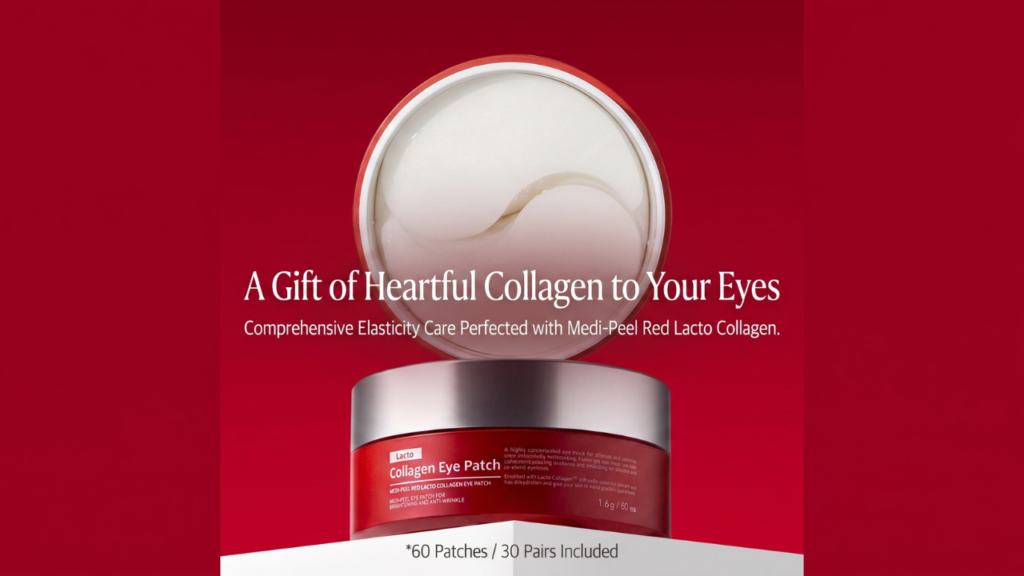
MEDI-PEEL Red Lacto Collagen Eye Patch Review: The Fermented Collagen Secret Behind K-Beauty’s Favorite Eye Fix

If there’s one area of the face that gives away a late night, a long flight, or one too many hours staring at a screen, it’s the under-eye. Korea’s skincare labs have spent years engineering solutions for exactly this problem, and few brands have tackled it with as much scientific ambition as MEDI-PEEL — the derma-focused label beloved for its “high-functionality” homecare formulas. Today we’re putting the MEDI-PEEL Red Lacto Collagen Eye Patch under the microscope: what’s actually in it, who it’s for, and why it’s become a quiet cult favorite among Olive Young shoppers.
Beauty disclaimer: individual results vary based on skin type, routine, and consistency of use. We always recommend a patch test on the inner arm 24 hours before applying any new product near the eye area.
The Trend: Why Fermented Collagen Is Dominating K-Beauty Right Now
The MEDI-PEEL Red Lacto Collagen Eye Patch didn’t appear out of nowhere — it’s the eye-area extension of a fermentation trend reshaping K-beauty formulation across the board. Korean R&D labs have moved past “just add collagen” formulations. The current trend — and the philosophy behind MEDI-PEEL’s Red Lacto Collagen line — is fermentation technology. Ingredients like bifida ferment and lactobacillus ferment lysate are cultivated the same way probiotic skincare pioneers first popularized years ago, but now they’re being paired with hydrolyzed collagen to create molecules that are smaller, more stable, and easier for skin to actually use.
Here’s the science in plain terms: fermentation breaks down collagen peptides into smaller fragments and generates beneficial byproducts (amino acids, postbiotics) along the way. Smaller fragments sit better on the skin surface, layer more comfortably under an eye cream, and support the skin’s own barrier function — which matters enormously in the eye area, where skin is up to five times thinner than the rest of the face and has virtually no oil glands of its own.
What’s Actually Inside the MEDI-PEEL Red Lacto Collagen Eye Patch
True to the Red Lacto Collagen line’s signature complex, the MEDI-PEEL Red Lacto Collagen Eye Patch is built around a trio of technologies:
- Fermented collagen complex (bifida and lactobacillus ferment lysates plus hydrolyzed collagen) to visibly firm and hydrate the delicate under-eye area
- Hyaluronic acid and humectant carriers like glycerin and betaine that pull moisture into the skin and keep the patch adhered and cooling during wear
- Peptide and amino acid support (the same amino-acid building blocks — glycine, proline, arginine — found across the Red Lacto Collagen family) to reinforce the skin’s own structural proteins over time
Because formulas are periodically updated, always double-check the full ingredient list on the product packaging or official Olive Young listing before purchase, especially if you’re managing a known allergy or sensitivity.
A Quick Glossary: What These Ingredient Names Actually Mean
K-beauty ingredient lists can look intimidating at first glance, so here’s a simple breakdown of what’s doing what in a formula like this:
- Bifida/Lactococcus/Lactobacillus ferment lysate: These are the “postbiotic” byproducts left behind after beneficial bacteria strains ferment a nutrient medium. They’re prized in Korean formulation for skin-conditioning and barrier-supporting properties, without the live bacteria itself being present in the final product.
- Hydrolyzed collagen: Collagen that has been broken down into smaller peptide fragments through hydrolysis. This doesn’t rebuild the collagen network deep in the dermis the way an in-office treatment might, but topically it functions as an effective humectant and film-former, helping the skin surface look plumper and feel more supple immediately.
- Sodium hyaluronate / hyaluronic acid: A moisture-binding molecule that can hold significantly more water than its own weight, making it a staple humectant in nearly every modern K-beauty formula, including eye patches.
- Niacinamide: Vitamin B3 in cosmetic form — included across much of the Red Lacto Collagen range to support barrier strength and even out the look of the skin over time.
- Amino acids (glycine, proline, arginine, and similar): The literal building blocks of collagen and elastin. Including free-form amino acids alongside hydrolyzed collagen is a common K-beauty formulation strategy to support the skin’s own protein synthesis pathways.
Understanding this vocabulary is genuinely useful beyond this one product — once you can read a K-beauty ingredient list confidently, you’ll start noticing which “trend” ingredients are backed by real formulation science versus which ones are mostly marketing.
Who Should Add This to Their Routine
Eye patches aren’t one-size-fits-all, and the MEDI-PEEL Red Lacto Collagen Eye Patch is no exception. Here’s how it tends to perform across different skin profiles:
- Dry or dehydrated skin: The humectant-rich, collagen-forward formula is a strong match — expect a plumper, more cushioned look immediately after removal.
- Normal/combination skin: Works well as a 2–3x weekly reset, especially before events or after a poor night’s sleep.
- Sensitive skin: The fermented ingredients tend to be gentler than raw actives, but because this is an eye-area product, we still recommend a patch test — apply a small piece to the inner forearm and wait 24 hours before your first full use.
- Mature skin focused on firmness: Consistent use (2–3x weekly over 4–8 weeks) is where collagen-support formulas like this tend to show their best cumulative results — patience is part of the process.
One important expectation to set: an eye patch is a hydrating, plumping, cosmetic treatment — not a medical or permanent solution for wrinkles or under-eye bags. Think of it as instant refreshment with a supportive, longer-term skin-conditioning benefit, not a substitute for retinol, sun protection, or a dermatologist’s guidance on deeper concerns.
How It Compares to Other Under-Eye Formats
Korea’s eye-care category spans several formats, and it helps to know where a fermented collagen patch fits:
- Vs. hydrogel-only patches: Plain hydrogel patches deliver mostly water and a cooling sensation. A collagen-and-ferment patch like this one layers active ingredients into that same cooling delivery system, so you get the sensory benefit plus a functional skincare payload.
- Vs. eye creams: Eye creams are built for daily, long-term barrier maintenance and are typically lighter in texture for all-day wear under makeup. Patches are an intensive, occasional treatment — think of them as the “sheet mask” equivalent for the eye area, layered on top of (not instead of) your regular eye cream.
- Vs. gold or microcurrent eye devices: Device-based treatments work mechanically to stimulate circulation and product absorption. Patches work purely through ingredient delivery. Many Korean routines actually combine the two — applying a patch, then using a cooling roller or gua sha tool over it for added benefit.
In other words, this eye patch isn’t meant to replace your existing eye cream — it’s designed to sit alongside it as a weekly (or twice-weekly) booster for moments when your under-eyes need extra attention.
How to Use the MEDI-PEEL Red Lacto Collagen Eye Patch (Step by Step)
- Cleanse and tone first. Apply the patches to freshly cleansed, toned skin so the essence can absorb without competing with makeup or SPF residue.
- Position under each eye. Gently unfold the patch and press it into place, following the natural curve of your under-eye area. Avoid direct contact with the eyes themselves.
- Leave on for 15–20 minutes. This is the sweet spot for most Korean hydrogel and essence-soaked patches — long enough for active absorption, short enough to avoid the patch drying out and pulling moisture back from the skin.
- Remove and pat in the remaining essence. Don’t rinse — use your ring finger (the lightest-pressure finger) to gently pat any leftover serum into the skin.
- Follow with eye cream and SPF (AM) or a night cream (PM). The patch preps the area; your daily eye cream and sunscreen lock the results in and protect your investment.
Pro tip from the K-beauty community: chill the unopened patch pouch in the refrigerator for an hour before use. The cooling effect enhances the de-puffing sensation, which makes this a favorite “morning of” trick before video calls, flights, or photos.
Storage, Shelf Life, and Getting the Most Out of Each Box
Like most essence-soaked patches, the MEDI-PEEL Red Lacto Collagen Eye Patch is sold in individually sealed pouches, which is a meaningful advantage over jar-packaged alternatives — each patch stays sterile and fully saturated until the moment you open it, with no risk of the remaining product drying out or becoming contaminated between uses. A few practical tips:
- Store the full box away from direct sunlight and extreme heat, ideally in a bathroom cabinet or bedroom drawer rather than a windowsill.
- Once a pouch is opened, use both patches immediately — they’re designed for single-session use and shouldn’t be saved for later.
- If you like the cooling effect, refrigerate a few sealed pouches at a time rather than the whole box, so the rest of your stock stays at a stable room temperature.
- Always check the Period-After-Opening (PAO) symbol on the packaging — the small open-jar icon with a number and “M” (for months) — for the manufacturer’s recommended usage window.
Ready to Try It? Choose the Store That Works Best for You:
We link straight to the official retailer — no extra click through a shop page.
🇺🇸 US Residents — Olive Young US (Fastest shipping, US returns) 🌍 Outside the US / Best Price — Olive Young Global (Lower price, more free gifts) 📦 Prefer Amazon? — Shop on Amazon (Prime shipping & easy returns)These are affiliate links; we may earn a commission at no extra cost to you.
Curious how the MEDI-PEEL Red Lacto Collagen Eye Patch fits into a full routine? Pair it with our guide to the best Olive Young eye creams for tired mornings, or browse our full roundup of Korean fermented skincare essentials to see how fermentation technology shows up across cleansers, ampoules, and creams.
Frequently Asked Questions
How often should I use the MEDI-PEEL Red Lacto Collagen Eye Patch?
For general maintenance, 2–3 times a week is typical in Korean skincare routines. Many users apply it nightly during the first week of a new box to “reset” tired-looking under-eyes, then settle into a lighter maintenance schedule. Daily use is generally safe for this type of hydrogel patch, but listen to your skin — if you notice any tightness or redness, scale back frequency.
Is this eye patch suitable for sensitive or acne-prone skin?
Fermented collagen formulas tend to be well tolerated because the fermentation process breaks ingredients down into gentler, more bioavailable forms. That said, the under-eye area is thin and reactive on everyone, so we always recommend a 24-hour patch test on the inner arm before your first application — especially if you have a history of fragrance sensitivity or reactive skin. If irritation occurs, discontinue use and rinse the area with water.
Why does WEMMERCE recommend this product?
We evaluate K-beauty products based on formulation transparency, ingredient technology, and how well a brand’s claims line up with real Korean skincare science — not just trending packaging. MEDI-PEEL has built its reputation on derma-inspired, high-functionality formulas backed by patented technology, and the Red Lacto Collagen line applies that same rigor to fermentation science. We link only to official retailers (Olive Young and Amazon) so you’re always buying an authentic, correctly stored product.
✨ Weekly K-Beauty tips & skincare secrets — straight to your inbox
Free subscription · Cancel anytime